Why the State Doesn't Need to Break Encryption Anymore
At 6:05 AM on January 14, 2026, federal agents raided the Virginia home of *Washington Post* reporter Hannah Natanson, seizing her phone and exposing 1,169 secure Signal contacts. This single morning raid proved that the state does not need to outlaw encryption when it can simply seize the physical devices holding the keys.
The Brief
The Day the Signal Went Silent
Source: blogs.mediapart.fr
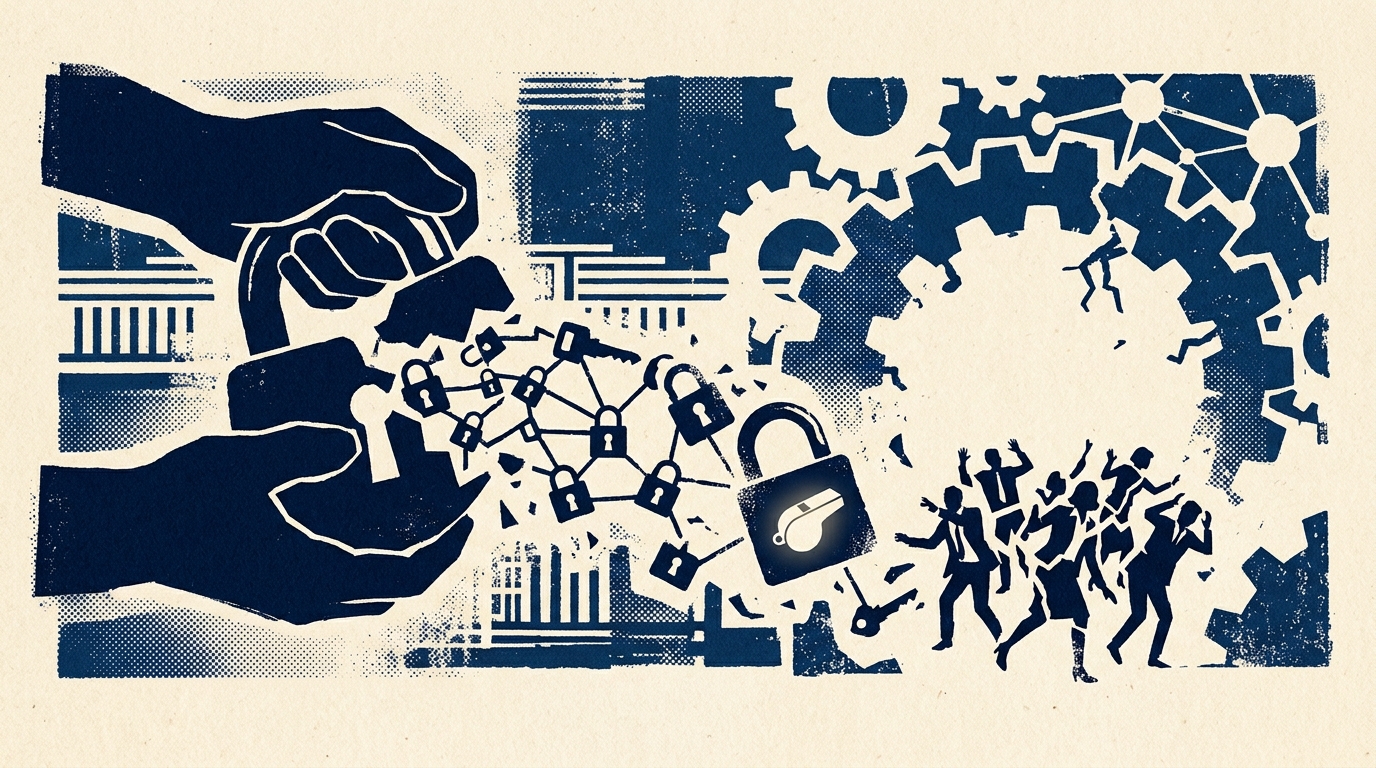
When the FBI broke through Hannah Natanson's door, they weren't just looking for physical evidence of a defense contractor's leak. They walked away with two laptops, a phone, and a recorder containing the identities of 1,169 federal employees who had used the encrypted messaging app Signal to blow the whistle on the new Department of Government Efficiency.
By the time federal judges stepped in to block a general search of her devices, the damage was done: Natanson's source network had completely dried up. This raid is part of a broader campaign by federal agencies to bypass constitutional protections by targeting the digital footprints of journalists and dissenters.
While the DOJ eventually dropped subsequent grand jury subpoenas against reporters in June, the chilling effect on whistleblowers remains absolute. Compounding this threat, the administration recently proposed mandatory non-disclosure agreements for all federal employees, backed by civil and criminal penalties.
This effectively criminalizes the act of sharing even unclassified, sensitive information with the press.
By the numbers
When the state can use leak investigations to map out entire networks of encrypted communications, the promise of secure messaging apps becomes an illusion. This is not just an attack on press freedom; it is a systematic dismantling of your ability to see what the government is doing behind closed doors.
If federal employees cannot safely speak to reporters, the executive branch operates entirely in the dark, free from public accountability. Your right to a transparent government depends on the survival of these confidential channels.
The federal government has realized it doesn't need to break Signal's encryption when it can simply take your phone and copy the contact list.
What happens next: The fight now moves to the courts and Congress, where civil liberties groups are pushing to codify stronger protections for journalists.
Watchlist
- FISA Section 702 battle shifts to March 2027 expiration.
- Kansas City prepares to launch real-time facial recognition on public buses.
- Congress faces mounting pressure to pass the Government Surveillance Reform Act.
More headlines
- Supreme Court Restricts Geofence WarrantsPrivacy
In a landmark 6-3 decision in Chatrie v. United States, the Supreme Court ruled that police acquisition of mobile geolocation data from third parties constitutes a Fourth Amendment search requiring a warrant.
Crow's Nest While Justice Alito grumbled in his dissent about this being an "irresponsible escapade," the Court has finally drawn a hard line against the state's favorite mass-harvesting shortcut.
- House Passes KIDS ActSpeech
The U.S. House of Representatives passed the Kids Internet and Digital Safety (KIDS) Act in a 267-47 vote, advancing a bill that critics warn will mandate invasive digital ID and age-verification systems.
Crow's Nest Trading your digital privacy and anonymity for a false sense of security is a classic legislative trap, and the KIDS Act is the latest Trojan horse.
- Widespread Backlash to Flock Safety ALPRsSurveillance
Florida GOP Chairman Evan Power and congressional candidate Keith Gross called for a complete ban on Flock Safety's AI-powered license plate readers as over 30 municipalities nationwide canceled their contracts.
Crow's Nest Local governments are finally realizing that outsourcing public surveillance to a private corporation creates a massive, unaccountable tracking network.
Take Action
Tell Congress to Stop Warrantless Surveillance and Reform Section 702
With Section 702 technically expired but surveillance continuing under existing certifications until March 2027, your representatives must hear that any reauthorization must require a warrant for backdoor searches.
The tools of state power are only as quiet as the public allows them to be. Keep your eyes open, and we'll keep watching the horizon.