The Roadside Snitch: Your Car Now Tracks Your AirPods
Your car does not just broadcast its license plate to roadside cameras anymore. It now broadcasts your AirPods, your smartwatch, and your phone to any police department with the right hardware upgrade.
The Brief
The Roadside Snitch: How SignalTrace Links Your Car to Your Devices
Source: 404media.co
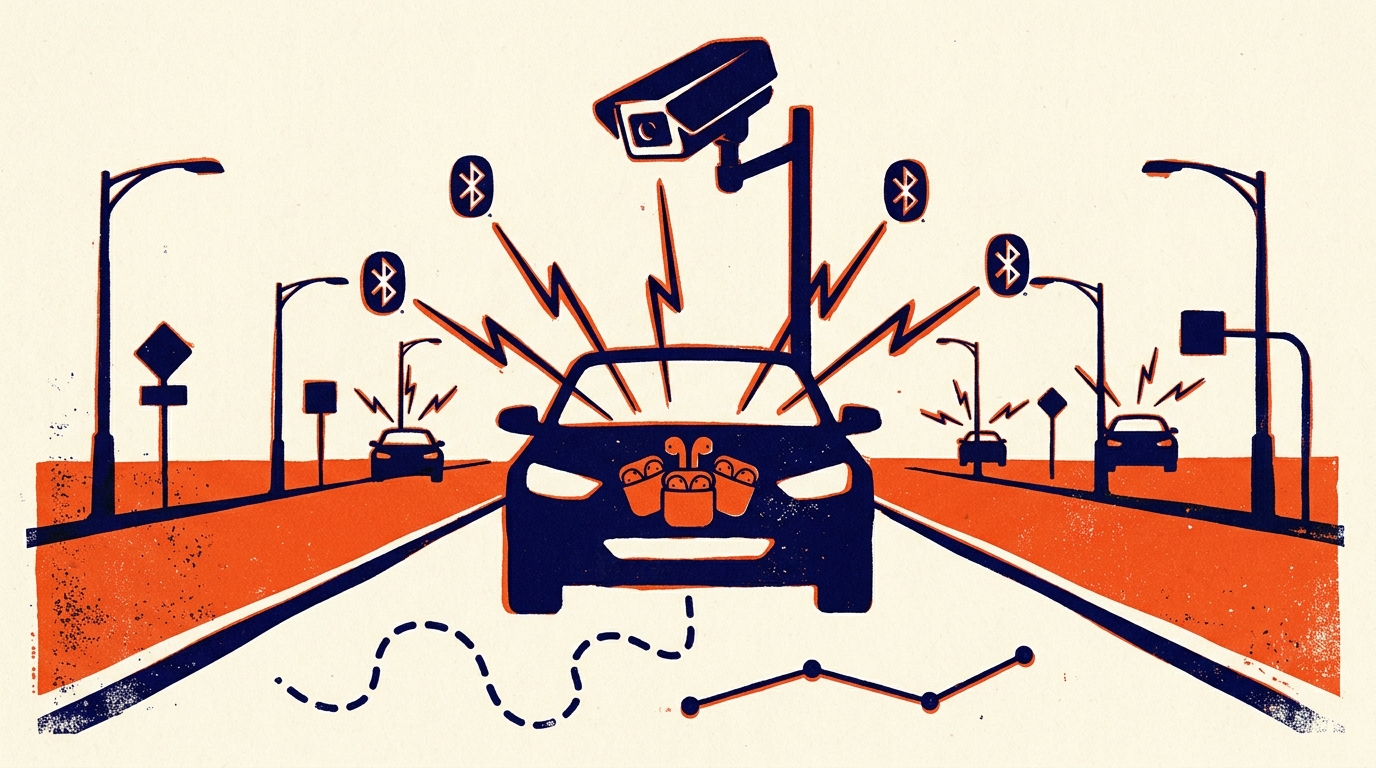
On July 5, investigative reports confirmed that defense contractor Leonardo is attaching its new SignalTrace sensor package to Flock Safety's network of up to 100,000 roadside cameras. The system passively sweeps for Bluetooth, Wi-Fi, and RFID (radio-frequency identification) signals, matching your vehicle's license plate to the unique electronic signatures of your phone, watch, and even your pet's microchip.
This is not a hypothetical threat. In Florida, a police officer used Flock's network to stalk his ex-girlfriend for months, while a Missouri officer ran 542 unauthorized searches to monitor his wife.
With SignalTrace, rogue actors and state agencies do not just see where a car went—they see exactly who was sitting in the passenger seat. The timing of this rollout clashes directly with the U.S.
Supreme Court's June 29 ruling in Chatrie v. United States, which declared that location tracking via geofence warrants constitutes a Fourth Amendment search requiring a warrant.
By the numbers
While courts historically treated license plates as public information, SignalTrace shifts the target from your car to your actual body. It builds a permanent, retrospective profile of your associations, habits, and movements without a warrant.
Because these databases are centralized, they are also prime targets for hackers. If a rogue officer or a malicious actor breaches the system, they gain access to a physical-to-digital map of your daily life.
The state no longer needs to plant a tracker on your car when your headphones are already broadcasting your identity to every light pole on the highway.
What happens next: Watch the Fourth Circuit Court of Appeals, where the remanded Chatrie case will set the boundaries for whether passive radio harvesting requires a warrant.
Watchlist
- The Chatrie Remand: How the Fourth Circuit will apply new geofence limits to passive tracking.
- The García-Perry Vote: Congress decides whether to strip highway funds from tracking states.
- Maine's ALPR Ban: State lawmakers vote on a total ban of license plate readers.
Bright Spot
Local city councils routinely buy into these tracking networks under the guise of public safety, completely ignoring the constitutional liability they invite when private companies hold the keys to their residents' daily movements.
More headlines
- The García-Perry AmendmentEconomic
Representatives Jesús "Chuy" García and Scott Perry introduced a bipartisan amendment to block state and local governments from using federal highway funds for non-toll license plate readers.
Crow's Nest Cutting off the federal money printer is the single most effective way to stop local police departments from acting as unpaid data-collection agents for defense contractors.
What you can do: Contact your congressional representative and urge them to vote "Yes" on the García-Perry amendment. - The European FirewallPrivacy
French national broadcaster Franceinfo confirmed that while SignalTrace is operational in the U.S., immediate deployment in France is highly unlikely due to strict EU legal barriers.
Crow's Nest While American law enforcement operates in a regulatory vacuum that treats our public airwaves as a free-fire zone, European courts continue to recognize that mass, indiscriminate data collection is fundamentally incompatible with a free society.
Take Action
Block Federal Funding for Roadside Trackers
The amendment is heading to a vote this month and needs bipartisan pressure to survive committee markups.
Your movements are your own business, not a data point for a defense contractor's ledger. Keep your Bluetooth off when you hit the highway, and we'll keep watching the watchmen.