The Chainsaw Veto: Americans Are Sawing Down the AI Surveillance Grid
Over the Fourth of July weekend, some South Carolinians celebrated independence by physically sawing down municipal surveillance camera poles. It is the latest flashpoint in a growing, decentralized rebellion against Flock Safety's warrantless tracking network.
The Brief
The Great Deflocking: Citizens Saw Down the AI Surveillance Grid
Source: wbtv.com
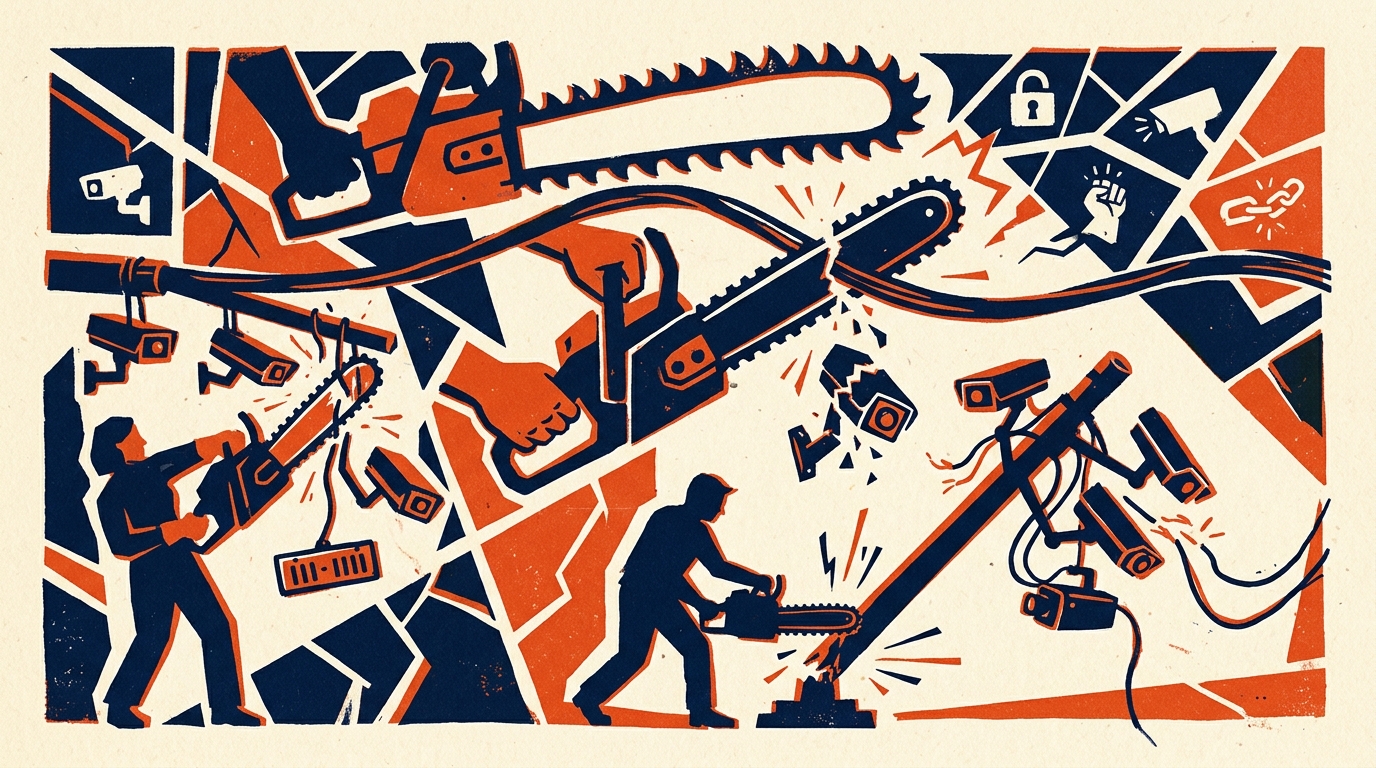
When Air Force mechanic Jeffrey Sovern grew tired of automated license plate readers tracking his Virginia neighborhood, he didn't write a letter to his city council. Instead, police say he grabbed a chainsaw and disabled over a dozen cameras by cutting them down at the base or throwing them into the street.
Sovern now faces 25 criminal charges, but his defense has struck a chord with a frustrated public. He has raised more than $25,000 from 740 small-dollar donors to fund a legal challenge centered on the Fourth Amendment.
His stand is no longer isolated, as police in Pageland, South Carolina, confirmed that two more Flock camera poles were intentionally cut down over the holiday weekend. Flock Safety, a private firm valued at over $7 billion, operates up to 100,000 cameras across 49 states, scanning 20 billion license plates a month.
But the corporate-state alliance is fracturing as cities like Fort Collins, Colorado, cancel their contracts over privacy and corporate data ownership concerns.
By the numbers
- Jeffrey Sovern, a 41-year-old Air Force mechanic, faces 25 criminal charges in Virginia for disabling Flock cameras.
- Sovern's legal defense fund has raised $25,496 from more than 740 individual donors.
- Flock Safety's network scans over 20 billion license plates every month across 49 states.
- At least 82 cities across 28 states have canceled their Flock contracts, with 39 pulling the plug in the first five months of 2026.
- The Supreme Court ruled 6–3 in Chatrie v. United States on June 29, 2026, declaring digital location tracking a search under the Fourth Amendment.
This physical rebellion exposes a deep constitutional friction over who controls public space. Flock's business model relies on a "consent gap," where private homeowners associations (HOAs) and local police install cameras without public votes, then share that data with federal agencies.
The Supreme Court's June 29 ruling in Chatrie v. United States has armed privacy advocates with a devastating legal weapon to dismantle these networks in court.
When a private company holds the keys to your daily movements, public accountability vanishes. If local governments can bypass competitive bidding and public consent to install these eyes, citizens will continue to find their own ways to turn them off.
A private company built a national tracking network without a single public vote, and now citizens are voting with chainsaws.
What happens next: Keep a close eye on the Fourth Circuit Court of Appeals in Schmidt v. City of Norfolk, where applying the Chatrie precedent to Norfolk's 175-camera Flock network could mandate warrant requirements for license plate databases nationwide.
Watchlist
- The Chainsaw Defense: Air Force mechanic Jeffrey Sovern faces 25 criminal charges in Virginia.
- The Warrant Requirement: The Supreme Court's Chatrie ruling threatens the business model of license plate readers.
- Municipal Defections: Over 80 cities have canceled their contracts with the private surveillance giant.
Bright Spot
When the state refuses to tell you where its eyes are, mapping them yourself is an act of basic civic hygiene.
More headlines
- The Stalker Cam RevelationsDue Process
The Institute for Justice has documented 21 confirmed cases of law enforcement officers abusing Flock data for personal surveillance.
Crow's Nest Giving police access to a frictionless, warrantless tracking database guarantees it will be used to settle personal scores.
- Troy, New York's Emergency Power StruggleProperty
The Troy City Council proposed a charter amendment to strip Mayor Carmella Mantello of her ability to declare emergencies to bypass competitive bidding.
Crow's Nest When politicians use "emergency" powers to force surveillance tech onto a community that explicitly rejected it, they reveal who they really serve.
When the state and its corporate partners build a digital fence around your neighborhood, they expect you to simply accept the new normal. But as the hum of chainsaws in the night suggests, some Americans still believe that liberty is worth defending, one camera pole at a time.