Dismantling the Watchtower One Camera Pole at a Time
Jeffrey Scott Sovern decided a wrench was the best tool to defend the Fourth Amendment. For six months, the Air Force mechanic systematically disabled the automated cameras tracking his Virginia neighborhood.
The Brief
The Airman, the Wrench, and the $7.5 Billion Tracking Grid
Source: yahoo.com
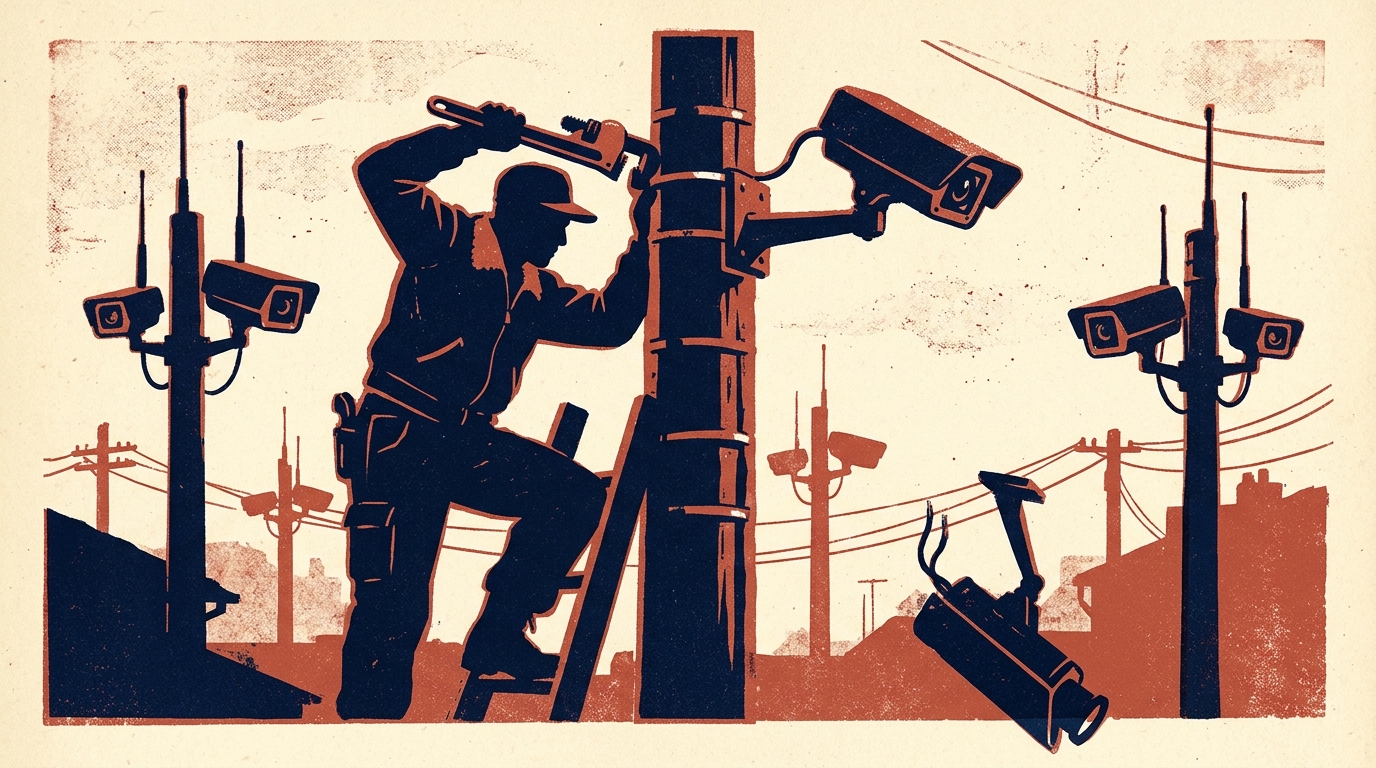
On June 26, 2026, Judge Nicole Belote certified 25 criminal charges against Jeffrey Scott Sovern, sending the Air Force mechanic's case to the Suffolk Circuit Court. Sovern spent six months in 2025 waging a physical campaign against automated license plate readers (ALPRs) in his neighborhood, first turning the cameras toward the woods and eventually knocking down the poles.
He stands charged with 13 counts of property destruction, six counts of petit larceny, and six counts of possessing burglary tools. During his interrogation, Sovern told detectives he targeted the devices because warrantless mass tracking violates the Fourth Amendment.
While his lawyer faces an uphill battle defending property destruction, the physical rebellion highlights a growing backlash against private tracking networks. Flock Safety, the private firm behind the devices, operates an estimated 100,000 cameras across 49 states.
Yet, the company's rapid expansion is hitting a wall, with at least 39 cities canceling their Flock contracts in the first five months of 2026 alone amid privacy concerns and security breaches.
By the numbers
- Jeffrey Scott Sovern, a 41-year-old Air Force mechanic, faces 13 counts of property destruction and 12 other charges in Suffolk, Virginia.
- Flock Safety is valued at $7.5 billion and captures over 20 billion vehicle scans per month.
- Each targeted camera setup is valued at approximately $1,650, including the camera, pole, and solar panel.
- At least 82 municipal contracts with Flock Safety have been canceled across 28 states since 2021.
- The U.S. Supreme Court ruled 6-3 in Chatrie v. United States on June 29, 2026, requiring warrants for cell phone location history.
"They are unconstitutional and a violation of his and others' Fourth Amendment rights." — Suffolk Police Detective Zach Hyman, testifying on Sovern's stated motive.
You cannot outsource the police state to a private corporation and expect the Constitution to look the other way. When local governments bypass the warrant requirement by renting private databases, they invite both legal challenges and desperate acts of physical resistance.
The Supreme Court's recent ruling in Chatrie v. United States confirms that citizens retain a reasonable expectation of privacy in their movements, signaling that the state's outsourced tracking grid is built on shaky legal sand.
If the state won't respect the Fourth Amendment, citizens will start bringing their own wrenches.
What happens next: Sovern will stand trial in Suffolk Circuit Court while the Fourth Circuit Court of Appeals decides the fate of warrantless tracking in Schmidt v. Norfolk.
Watchlist
- Sovern's Circuit Court Trial — A Virginia jury will decide if constitutional protest excuses property damage.
- The Fourth Circuit's Ruling — Schmidt v. Norfolk could outlaw warrantless license plate tracking across five states.
- Federal Funding Fight — Bipartisan legislation aims to strip highway funds from camera-reliant cities.
More headlines
- The False Arrest EpidemicDue Process
The Institute for Justice released a study on July 3, 2026, documenting how errors in automated license plate readers routinely lead to false arrests, including a Colorado man jailed for 13 days.
Crow's Nest Relying on unverified private databases to justify locking people in cages is a recipe for automated tyranny.
What you can do: Ask your local city council to mandate independent human verification of all automated plate alerts before officers initiate traffic stops. - The Georgia Drone CreepSurveillance
The Dunwoody, Georgia City Council voted unanimously to expand its Flock Safety contract, integrating 911 dispatch with aerial drones that track suspects at 60 mph.
Crow's Nest The surveillance state will always seek higher ground to evade physical accountability and public oversight.
- The Federal Highway Funding FightEconomic
Bipartisan federal legislation aims to bar state and local governments from using federal highway dollars to fund license plate readers for non-toll surveillance.
Crow's Nest Starving local police departments of federal subsidies is the most direct way to dismantle the nationwide tracking grid.
What you can do: Contact your U.S. Representative and urge them to co-sponsor the García-Perry highway funding amendment.
Take Action
This bipartisan amendment is the best chance to stop federal tax dollars from funding local tracking networks.
When the law fails to protect your privacy, the line between vandalism and vigilance begins to blur. Until next time, keep your eyes on the road—and the poles.